Fielding Our Future
One Island. One Project. Four Schools. Four Seasons.
This Decision Belongs to All of Us The facts are clear. The science is current. The need is real… Stay informed.
Overview of Question 2
This project is a renovation of Capizzo Stadium to meet the needs of today's and future students and the broader Nantucket community.
It includes a new regulation track, a turf field, ADA-compliant grandstands, a new Boosters building, and dark-skies-compliant lighting. Together, these improvements create an incredible facility that can support students, families, and community use throughout the year and for generations to come.
Right now, our facilities fall short in every one of these areas. They are outdated, overused, and in some cases unusable for regulation competition. This project addresses those gaps all at once, with a thoughtful, long-term solution.
But beyond the list of upgrades, this is about something simple.
It is about giving Nantucket kids a place that actually works for them.
 Track
Track
Our Nantucket track athletes have never had the chance to compete at home. Today, more than 70 high school students participate in track, yet not one home meet can be held here. Our track is not regulation. They must travel off-island for their "home meets".
Think about that. No home crowd. No familiar field. No chance for parents, grandparents, and classmates to gather and cheer them on their home field.
A regulation track changes that. It brings those moments home, where they belong.
 Field
Field
Our grass fields are pushed beyond their limits. Weather frequently cancels games. Overuse can lead to unsafe conditions. Practices get squeezed into whatever space is available. The result is not just inconvenience. It is lost opportunities.
A high-performance field creates consistency. It gives every team a dependable place to play, across seasons, without constant disruption. It takes pressure off every other field on the island and makes the entire system work better.
 Grandstands
Right now, not everyone in our community can easily access or fully enjoy events at the stadium. ADA-compliant grandstands change that. They make it possible for everyone to be part of the experience. To show up and cheer on their beloved Nantucket Whalers.
A new press box also brings the facility up to a level that properly supports games and events, improving visibility, organization, and the overall experience for athletes, spectators, and the community. That matters.
 Facilities
Games, events, and community gatherings rely on basic infrastructure that we currently lack. Updated restrooms and a new Boosters building provide the essential support needed for students, families, and volunteers.
These are the details that turn a field into a functional, welcoming place for the entire community.
 Lights
Nantucket's seasons and daylight hours are not always on our side. Dark-skies-compliant lighting allows for more flexibility, more practice time, and more opportunities to play, while still respecting the island's environmental priorities.
Turf vs Grass
Same data, side by side. Grass on the left, the proposed turf system on the right.
- NPS Existing Soil PFAS Test Results (Alpha Analytical report, Oct 2021)
- Weston & Sampson, PFAS Testing Report for Nantucket Public Schools (Dec 2025)
- NPS Field Use Matrix, 2024–25; Weston & Sampson, Nantucket Parks & Recreation Master Plan — recommends 250–300 hrs/season for Nantucket natural fields (via MV Times, 2022); Ebdon et al., "Wear tolerance and carrying capacity of C3 turfgrasses," Crop Science 61(1):693–706 (2021) — peer-reviewed, UMass Amherst lead author
- Montgomery County OLO Report 2024-12, Athletic Field Maintenance Costs
- Penn State Extension, "Turfgrass Fertilization: A Basic Guide for Professional Turfgrass Managers" — typical athletic-field nitrogen application rates (5–7 lbs N per 1,000 sq ft/yr = 218–305 lbs/acre/yr)
Injuries: What the Evidence Shows
Claims about turf-related injuries are frequently oversimplified. While professional athletes experience higher rates of certain ankle and foot injuries on turf, overall injury rates are comparable between well-maintained grass and modern synthetic fields[3].
What is rarely discussed: modern turf systems are engineered to absorb impact and have been associated with reduced severity of head-to-ground injuries, specifically concussion symptoms[4]. For high school athletes, where concussion prevention is a critical priority, this is a meaningful consideration.
Our students are not professional athletes competing on NFL-level surfaces. Comparing youth athletic conditions to professional leagues overlooks significant differences in age, physical development, and the resources available for field maintenance. A high school field that sees 1,300 hours of use per year[1] should not be directly compared to a professional field that sees fewer than 75 hours[1].
- Nantucket Current, "In Turf Field Debate, Washington D.C. Think Tank Fails to Consider Our Student Athletes"
- Athletic Business, "School district's failure to correct dangerous field condition leads to $31M settlement"
- Gould et al., "Lower Extremity Injury Rates on Artificial Turf Versus Natural Grass Playing Surfaces: A Systematic Review," American Journal of Sports Medicine (2022)
- Hansen et al., "Impact of Playing Surface on Concussion Symptoms in Young American Football Players" (UT Southwestern, 2023) — grass concussions: 10.3 symptoms / severity 26.6; turf concussions: 5.9 / 11.6
Nitrogen & Fertilizer — The Health Crisis No One Talks About
Nitrogen fertilizer use in the United States has grown from roughly 2.7 million tons in 1960 to 11.6 million tons in 2021[6] — more than a four-fold increase. Only about 50% of applied fertilizer actually reaches plants[7]; the rest leaches into groundwater, streams, and coastal waters.
Grass athletic fields typically receive hundreds of lbs of nitrogen per year[8], depending on grass type and traffic, feeding directly into that runoff.
A 2024 peer-reviewed study in Public Health (Mendy & Thorne) associated drinking-water nitrate exposure with 73% higher cancer mortality — even at levels below current EPA limits[1].
Cape Cod's situation illustrates the broader crisis: 90% of coastal bays are rated "unacceptable"[3] for water quality, driven by 6 million pounds of fertilizer and 1.3 million pounds of pesticides applied annually[9]. Cleanup costs are projected to exceed $4 billion over the next 50 years[10].
Worldwide, nitrogen pollution has contributed to more than 400 dead zones[4] covering an area larger than the United Kingdom. The Gulf of Mexico dead zone alone causes $2.4 billion per year[5] in fisheries damage.
- Mendy & Thorne, "Long-term cancer and overall mortality associated with drinking water nitrate in the United States," Public Health 228 (Feb 2024) — peer-reviewed
- Nantucket Current, "Nantucket Voters Endorse Island-Wide Ban on Fertilizer"
- Association to Preserve Cape Cod, State of the Waters: Cape Cod — 2023 Water Health Report (Jan 2024) — 43 of 48 evaluated coastal embayments (90%) rated "unacceptable" for water quality
- Diaz & Rosenberg, "Spreading Dead Zones and Consequences for Marine Ecosystems," Science (AAAS)
- Rabotyagov et al., "The Economics of Dead Zones: Causes, Impacts, Policy Challenges, and a Model of the Gulf of Mexico Hypoxic Zone," Review of Environmental Economics and Policy 8(1):58–79 (2014) — peer-reviewed
- USDA Economic Research Service, "Fertilizer Use and Price" — U.S. nitrogen fertilizer consumption, 1960 and 2021
- Eos (American Geophysical Union), "Index Suggests That Half of Nitrogen Applied to Crops Is Lost"
- Athletic-field nitrogen application rates: Penn State Extension (2–4 lbs N / 1,000 sq ft/yr for cool-season turfgrass, with athletic fields requiring more than low-traffic areas) and NC State Extension (5–7 lbs N / 1,000 sq ft/yr for bermudagrass used for sports purposes) — combined range 2–7 lbs/1,000 sq ft/yr = 87–305 lbs/acre/yr.
- Cape Cod Commission, "Pesticides and Fertilizers" — 6 million pounds of fertilizer and 1.3 million pounds of pesticides applied annually on Cape Cod
- WBUR, "Cape Cod needs to clean up its water. The solutions could cost billions" (Feb 2024) — cleanup costs projected at ~$4 billion over 50 years per Cape Cod Commission
Water & Field Availability
Maintaining grass at Capizzo Stadium requires approximately 1.7 million gallons of water per year[1], drawn from Nantucket's sole-source aquifer. Synthetic turf requires zero irrigation. In October 2025, the island had escalated to Level 3, Critical Drought[2]. As of April 8, 2026, conditions have improved to Level 1[3]. January through March 2026 were the second driest on record for the county[4].
| Metric | Grass | Synthetic Turf |
|---|---|---|
| Annual water use[1] | 1.7M gallons | Irrigation not required. Incidental water required for rinse-off after spills, and similar cleanup and maintenance. |
| Days closed per year due to weather and maintenance[1]In addition to days closed for weather and maintenance, non-turf fields require months of “rest period” closure that turf fields do not require. | 30–50 days | Near zero |
| Healthy usage limit[5] | 600 hours/year | No practical limit |
| Actual Nantucket usage | 1,000–1,300+ hours | Designed for this level |
Grass athletic fields at Capizzo are typically closed November–April and June–August — plus an additional 30–50 days per year[1] due to weather and maintenance. Synthetic turf, by contrast, is playable 365 days a year. Professional grass fields sustain fewer than 60–75 hours of play per year[1] before requiring restoration; Nantucket's fields endure 1,000–1,300+ hours[1] — far beyond the 600–816 hour healthy usage range[5] established for natural grass athletic fields.
By the time a grass field hits 600 hours of use[5], it is already showing significant wear. Beyond that point, you are no longer maintaining the field — you are breaking it down[7].
- Nantucket Current, "In Turf Field Debate…" — field usage hours and water use; Weston & Sampson, Nantucket Parks & Recreation Master Plan — 250–300 hrs/season recommendation for Nantucket natural fields (via MV Times, 2022); Ebdon et al., Crop Science 61(1):693–706 (2021) — peer-reviewed cool-season wear tolerance
- Nantucket Current, "Critical Drought Conditions Declared on Nantucket"
- Mass.gov, Drought Status — Nantucket County improved to Level 1 Mild Drought (April 8, 2026)
- Drought.gov, Nantucket County Conditions — 2nd driest year to date over the past 132 years (January–March 2026), 4.86 inches below normal
- Montgomery County OLO Report 2024-12, Athletic Field Maintenance Costs — natural grass healthy usage limit (600–816 hours per year)
- CBS Boston, "Drought has sports fields across the state 'pretty burnt out right now'" (2022) — statewide grass-field conditions during the 2022 Massachusetts drought
- NC State Extension (Center for Environmental Farming Systems), "Maximizing the Durability of Athletic Fields" — turfgrass wear thresholds and field-degradation beyond healthy use limits
Why It Matters to Them
Summary of Weston & Sampson Study
Nantucket Public Schools hired Weston & Sampson — an independent environmental engineering firm — to test whether the proposed turf system contains PFAS[1]. Two accredited labs tested every component: the TenCate turf fibers, the Brock shock pad, and the BrockFILL organic infill.
No individual PFAS compounds were detected at concentrations above laboratory reporting limits in the tested synthetic turf system materials. Both individual PFAS compounds (40 tested via EPA Method 1633, modified using Method 537) and total fluorine were not detected above laboratory reporting limits[1].
The detection limit was 0.012 parts per billion — 5 to 91 times below Massachusetts' strictest soil safety thresholds[1]. Meanwhile, the 2021 NPS existing-soil test results show PFOS at 0.399–0.696 ppb in the grass field soil — 33 to 58 times higher than the proposed turf's detection limit[2]. The turf system's engineered drainage layer is designed to capture and direct runoff, adding a protective barrier that unlined grass fields do not have.
“We believe the synthetic turf components tested pose No Significant Health Risk from PFAS to field users or the environment.”[1]
The W&S report also evaluated whether PFAS could migrate out of the turf system into soil or groundwater over time. Their conclusion: “All regulated PFAS (PFAS6) and unregulated PFAS concentrations reported are well below the MassDEP drinking water and soil exposure standards.”[1]
In addition to the representative component testing W&S already completed, the specific materials selected for this project can be tested prior to installation, verifying the actual products before they go in the ground. That testing would use EPA Method 1633 — the current federal standard for PFAS in solid materials such as turf, soil, and plastics, which analyzes ~40 PFAS compounds[3].
- Weston & Sampson, PFAS Testing Report for Nantucket Public Schools (Dec 2025) — full 129-page report
- NPS Existing Soil PFAS Test Results (Alpha Analytical report, Oct 2021)
- US EPA Office of Water, "Method 1633A, December 2024" — federal standard for PFAS in aqueous, solid, biosolids, and tissue matrices; 40 analytes
But What About the Aquifer?
The natural grass conversation usually ignores the sole-source aquifer. It shouldn't.
Nantucket's drinking water comes from a sole-source aquifer designated by the EPA in 1983[1] — meaning more than 50% of the island's drinking water comes from this single underground source, with no reasonable alternative.
Protecting it matters. But the conversation around environmental scrutiny has focused almost entirely on synthetic materials while treating natural grass as if it were inherently safe.
Nitrogen in your drinking water, from a public health perspective, is incredibly dangerous. I would almost rather drink a little bit of a PFAS than a little bit of nitrogen.Roque MiramontesHealth & Human Services Director, Nantucket[4]
Nantucket would not be the first community to put turf on a sole-source aquifer. More than 130 Massachusetts schools sit over a sole-source aquifer[7], and at least 8 of them — including Barnstable High, Mashpee Middle-High, Nauset Regional, Monomoy Regional, Carver Middle/High, and Walpole High — already operate synthetic turf fields directly over that aquifer. And Long Island, New York — which sits entirely over the Nassau-Suffolk Sole Source Aquifer, designated by the EPA in 1978[6] — has 111 high school varsity football teams; 100 play on turf, only 11 still play on grass[5]. A sole-source aquifer does not mean no athletic fields. It means protection depends on regulation, design, and monitoring — which is exactly what the proposed turf system delivers.
How the field manages water
Rainwater on the proposed turf field is collected, filtered, and routed to a defined sample point — not allowed to flow off uncontrolled. The diagram below is the actual engineered system specified for Nantucket.
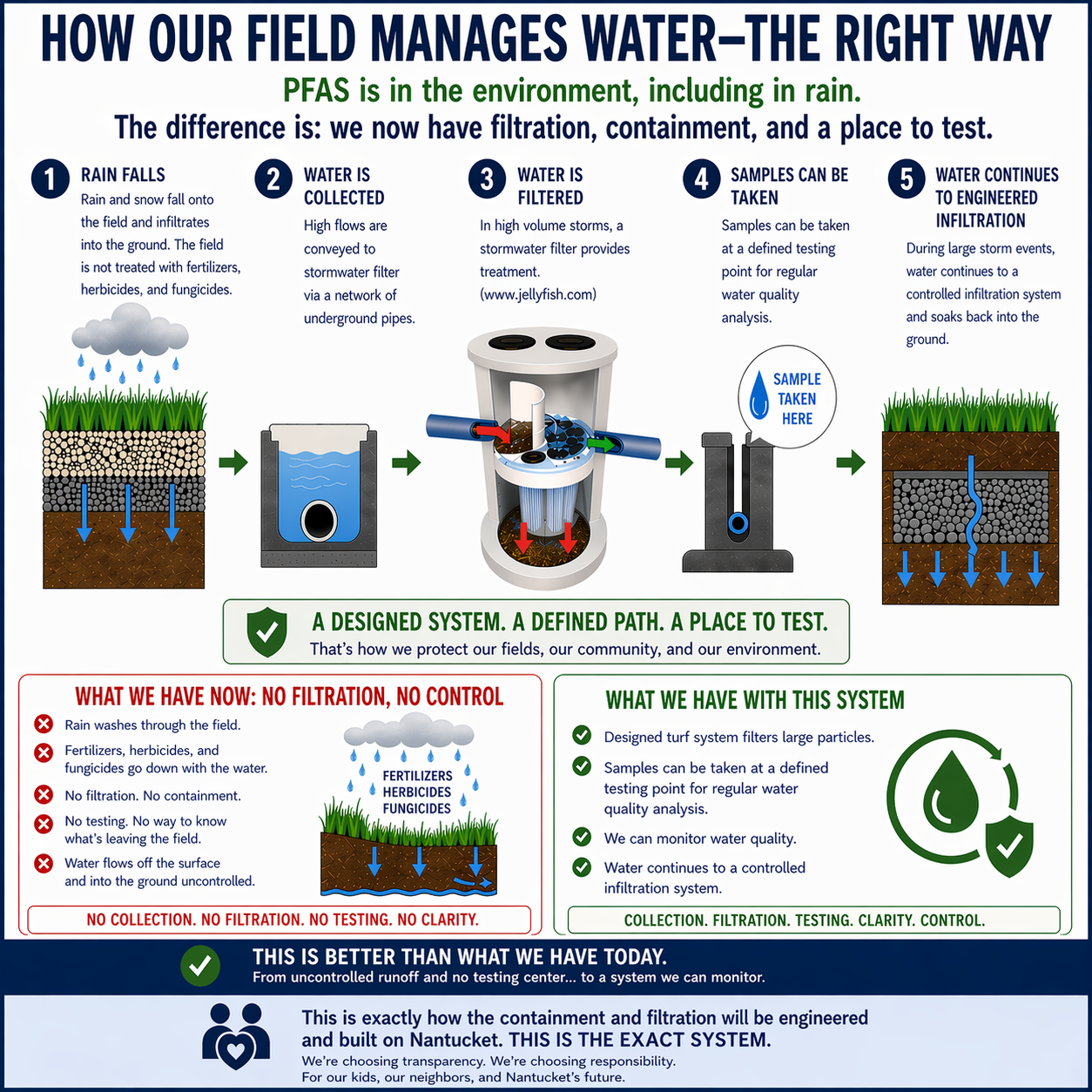
A Designed System with a Defined Path
With this system, rainwater does not move randomly through the ground. It follows a planned, engineered path.
- Water is collected and directed through an underground drainage system.
- It is filtered as it passes through a stormwater system that removes sediment and particles.
- A dedicated sampling point allows for regular water quality testing.
- Water is then released into a controlled infiltration system and safely returns to the ground.
This approach creates clarity, consistency, and the ability to monitor what is happening over time.
How This Differs from What We Have Today
On a typical grass field, water moves freely and unpredictably.
- Rain passes through the soil without collection or filtration.
- Fertilizers and lawn chemicals can travel with that water.
- There is no way to test or track what is leaving the field.
- Water either seeps into the ground or runs off without control.
In short, there is no defined system and no way to monitor outcomes.
Why This Matters
This system does not stop water from entering the environment, but it does something important.
It gives us a way to manage it, measure it, and understand it.
Instead of relying on assumptions, we have a clear pathway, built in filtration, and a place to test and monitor water quality over time.
It is the difference between uncontrolled runoff and a system that is designed, monitored, and accountable.
That is how we better protect our fields, our community, and our environment.
- US EPA Region 1, Nantucket Sole Source Aquifer — Federal Register notice June 13, 1983 (48 FR 27146)
- Nantucket Current, "In Turf Field Debate..." — Capizzo Stadium annual water use
- USGS, "National look at nitrate contamination of Ground Water" (NAWQA) — see also US EPA, "Nitrogen and Phosphorus Pollution Series: Nitrate in Ground Water"
- Nantucket Current, "Housing Or The Environment? Debate Emerges On Impacts Of Proposed Ban Nitrogen Loading Credits" — quote attributed to Health Director Roque Miramontes at Board of Health meeting
- Newsday (via Stony Brook Medicine), "Turf vs. Grass Debate" (Sept 24, 2023) — "Of Long Island's 111 HS varsity football teams: 11 use grass fields, 100 use turf fields."
- US EPA, Sole Source Aquifer Program — Nassau-Suffolk Aquifer System designated June 21, 1978 (43 FR 26611), the first regional sole source aquifer designated in EPA Region 2
- MassGIS Schools dataset (PK–12, public and private) spatial-joined against EPA Sole Source Aquifer polygons — analysis April 2026
Testing
How the proposed materials will be verified — before, during, and after installation.
The turf materials will be tested using EPA Method 1633, the current federal standard for PFAS testing in solid materials such as turf, soil, and plastics[1].
- Analyzes ~40 PFAS compounds[1]
- The appropriate and accepted method for non-liquid materials
- Provides independent, laboratory-verified results
Weston & Sampson has evaluated representative synthetic turf system materials similar to those proposed for this project. Their findings:
- No individual PFAS compounds were detected at concentrations above laboratory reporting limits in the tested synthetic turf system materials
- Levels comparable to or lower than background soil
In addition to the representative testing already completed:
- The specific materials selected for this project can be tested prior to installation
- Testing would use EPA Method 1633[1]
FAQ
Some questions that we're hearing from the community
The investment in the new Vito Capizzo Stadium is not just for a field—it's a full upgrade to a heavily used, aging facility that serves students and the entire community.
The project includes:
- New multi-sport fieldA durable playing surface designed to handle year-round use for soccer, football, lacrosse, and field hockey.
- Regulation trackA properly built track that allows Nantucket to host meets—something we currently can't do.
- New bleachers & grandstandsSafe, modern seating for spectators and school events.
- Field house & facilitiesNewly built locker rooms, bathrooms, storage, and support spaces for athletes and teams.
- ADA accessibility improvementsMaking the stadium accessible and usable for everyone in the community.
- Lighting (dark-sky compliant)Efficient lighting that meets dark-sky standards while allowing extended use of the field.
- Water management & filtration systemsEngineered drainage and filtration to responsibly manage runoff and protect the environment.
Because the track and field are built for higher usage and includes lighting, teams can:
- Practice in shifts throughout the afternoon and evening
- Continue after dark when needed
- Reduce scheduling conflicts and overcrowding
- Support boys and girls lacrosse
- Give the track team a regulation facility year-round, across all four seasons
- In the fall the field will be shared across the football, boys and girls soccer, and field hockey teams. In the spring the field will be shared across the boys and girls lacrosse teams, the track & field teams, and more.
For the broader community:
- The track provides a safe, flat, accessible surface for walking and fitness
The result: more teams practicing and playing safely on one field — across all seasons — while also creating a space the entire community can use and enjoy.
If this plan does not pass as designed, we do not just lose turf, we lose the solution. The school will be forced to limit access to sports and activities so the fields can rest, reducing opportunities for students across all programs. With four schools sharing one campus, the current grass fields simply cannot handle the level of use. The track remains non-regulation, meaning our athletes still cannot host meets at home.
Limiting access to sports does not just affect schedules, it affects kids' well-being, their sense of connection, and an important outlet for stress and mental health. This is not a tradeoff, it is a step backward that leaves the same problems in place and pushes real solutions further out of reach.
Crumb rubber is NOT being used in this project.
The proposed field at Vito Capizzo Stadium will use Brock infill, an organic/natural alternative, NOT recycled tire crumb rubber.
- No crumb rubber from recycled tires
- An infill designed with natural, plant-based materials
- A system aligned with newer field technologies and community concerns
This project reflects updated standards — moving away from crumb rubber and using a modern, organic infill instead.
Protecting Nantucket's aquifer is a top priority, and the design of the new Vito Capizzo Stadium reflects that.
What's built into the project:
- Engineered drainage systemThe field is designed to control and manage stormwater, rather than allowing uncontrolled runoff.
- Filtration layersWater passing through the system is filtered before entering the ground, helping reduce potential contaminants.
- No crumb rubber infillThe project uses organic Brock infill, not recycled tire crumb rubber (which is often the concern in older systems).
- Planned testing and oversightThe approach includes third-party testing and evaluation to ensure materials meet safety standards before installation.
Unlike older fields or unmanaged surfaces, this system is designed with modern environmental safeguards in mind, specifically to address concerns about groundwater protection.
The project is being designed to protect the aquifer through controlled drainage, filtration, and updated materials, to mitigate risk to groundwater.
Replacing grass with grass does not solve the underlying capacity problem. Nantucket's fields currently sustain 1,000–1,300+ hours of use per year[2], far beyond the 600-hour healthy usage limit[1] for a natural grass surface. Even a brand-new grass field would still be closed 30–50 days per year for weather and maintenance, and still require 1.7M gallons of irrigation annually.
We would need at least 4 additional fields to begin to address the usage issues that the school is facing.
Types of testing include:
- Pre-installation material testingThe exact lot of materials being used (including the infill) can be tested before installation to confirm they meet safety standards and do not contain concerning levels of contaminants.
- PFAS and chemical screeningTesting can evaluate for the presence of substances like PFAS and other chemicals of concern.
- Leachate testing (water interaction)Simulates how water moves through the field system to understand what, if anything, could leach out under real conditions.
- Stormwater and drainage performance testingEnsures the engineered system is functioning properly — managing and filtering water as designed.
For a Nantucket home valued at $2 million, the estimated cost would be about $90 per year.
Every property is different, so we encourage residents to use the Town of Nantucket's online tax calculator to see the estimated impact for their specific home.
Let's remember that with one turf field we are essentially getting 5 fields for the price of one. A properly maintained turf field typically lasts between 8 and 15 years, though, with exceptional care and moderate use, it can last up to 20 years or more[6].
The existing grass fields at Capizzo Stadium require significant annual maintenance labor, 1.7 million gallons of irrigation water drawn from the sole-source aquifer, and regular applications of nitrogen fertilizer and pesticides — on an island that voted 3-to-1 to ban fertilizer at the 2022 Town Meeting[2]. 2021 soil testing at NPS measured PFOS in the existing grass-field soil at 0.399–0.696 ppb, 33 to 58 times higher than the proposed turf's detection limit[4].
Despite that maintenance burden, the fields are still overused by roughly 2× their healthy capacity, closed for 30–50 days per year, and repeatedly described as unsafe during drought conditions — during the Massachusetts 2022 drought, grass fields statewide became "fields of sand."
Every component of the proposed turf system tested non-detect for PFAS at a detection limit of 0.012 ppb — 5 to 91 times below Massachusetts' strictest soil safety thresholds[3]. The system includes a sealed drainage and containment layer designed to substantially reduce leachate reaching groundwater.
By contrast, grass athletic fields typically receive hundreds of lbs of nitrogen per year plus pesticides, and existing NPS grass-soil PFOS measures at 0.399–0.696 ppb — 33 to 58 times the proposed turf[4]. A 2024 peer-reviewed study in Public Health (Mendy & Thorne) associated drinking-water nitrate exposure with 73% higher cancer mortality — even at levels below current EPA limits[5].
Yes. At the end of its life cycle, the turf can be mechanically recycled rather than sent to a landfill. The material can be processed at facilities such as Turf Recyclers in Rockland, Massachusetts.
- Montgomery County OLO Report 2024-12, Athletic Field Maintenance Costs
- Nantucket Current, "In Turf Field Debate, Washington D.C. Think Tank Fails to Consider Our Student Athletes" — cites >1,300 hours/year of use across Nantucket's playing surfaces
- Weston & Sampson PFAS Testing Report (Dec 2025) — proposed turf non-detect at 0.012 ppb
- NPS Existing Soil PFAS Test Results (Alpha Analytical report, Oct 2021)
- Mendy & Thorne, "Long-term cancer and overall mortality associated with drinking water nitrate in the United States," Public Health 228 (Feb 2024) — peer-reviewed
- AstroTurf, "Synthetic Turf Field Durability" — see also Keystone Sports Construction, "What Is The Lifespan Of Synthetic Turf". Industry sources on estimated synthetic turf field lifespan.
Have a Question?
Send us a DM via Instagram and we'll get back to you as soon as we can. For press inquiries, fact-checks, or anything we missed, this is the place.
Opens Instagram in a new tab. Don't have an account? You can view our page without signing in.
What This Really Comes Down To
This is not about turf versus grass.
It is about whether our kids have what they need.
It is about whether we provide safe, reliable, and accessible spaces for them to grow.
It is about showing up for them the same way they show up every day.
Right now, we are asking them to make do.
This project is about doing better. VOTE YES ON QUESTION 2.